
NETFLEX Sentinel AI
Introduction
Most CCTV in Africa records everything and reveals nothing, because no one has time to watch it. Sentinel connects to the cameras a business already has and watches all of them at once, alerting a person only when something worth seeing is happening.
Pictures
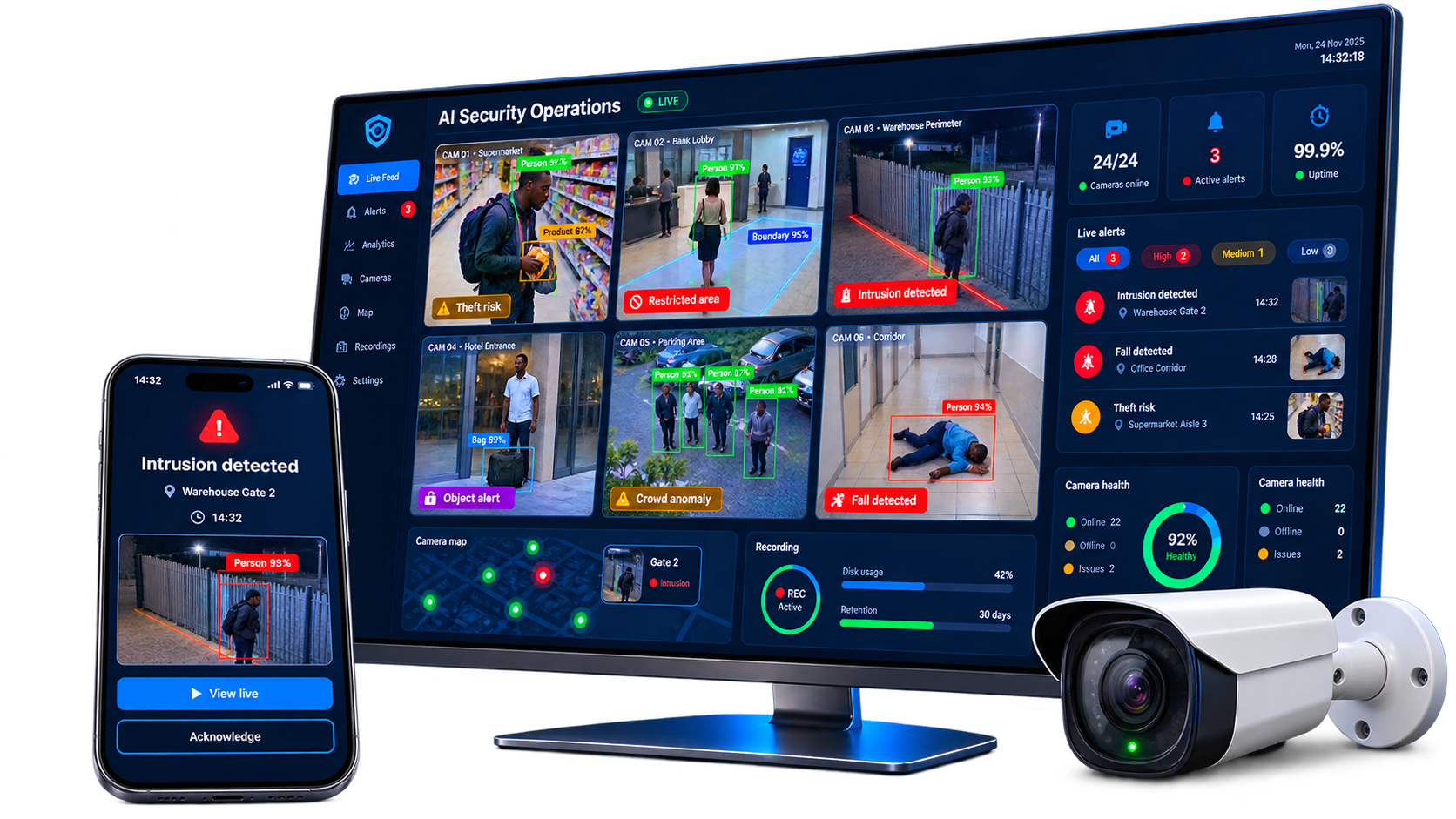
Concept illustration. Sentinel AI has not been deployed or piloted yet.
The problem
Cameras record. Nobody watches.
A supermarket owner finds stock missing at count and has no idea when it happened. A bank learns after a robbery that the same man stood outside for forty minutes on three separate days. The cameras saw it every time. Nobody did.
- Human monitoring does not scale past a few screens
- Reviewing footage after the fact is too slow to help
- Foreign AI products need fast internet and cost thousands a month
- Existing tools are not built for local bandwidth, power or lighting
Our solution
Local hardware, local rules, a person in the loop
Sentinel runs on a small computer installed on site, connected to the cameras a business already owns. It watches every feed at once, recognizes a defined set of behaviors (loitering, entry into a restricted area, a fall, a fight, an abandoned bag), and sends a real-time alert to a person. It never takes action on its own, and it never asks what someone's face is; only what they are doing.
How it works
What it does
Works with existing cameras
No new cameras and no new wiring. It connects to what is already installed.
Runs without internet
The computer sits inside the building. It keeps working when the connection drops.
Watches behaviour, not faces
Loitering, restricted areas, falls, fights and abandoned bags. No facial recognition, ever.
Saves evidence automatically
Thirty seconds before an event, the event, and ninety seconds after.
A person decides
Sentinel alerts. It never acts on its own against a person, and every decision is logged.
Built and trained locally
Local video, local rules, and registration with the data protection authority in every market it runs in.
Objectives
What has to be true before this ships.
- 1Run four free pilots in Kampala before any commercial rollout
- 2Prove detection accuracy against real footage before charging for it
- 3Register with the data protection authority in every market it operates in
- 4Keep a human decision in every alert that concerns a person, always
Benefits
What changes for the people who use it.
- Losses get noticed while they're happening, not at the next stock count
- No new cameras or wiring: it runs on what's already installed
- Keeps working through a power cut or a dropped connection
- Every alert leaves a reviewable, timestamped record
Open to partnering
Want to help shape this, or pilot it first?
We are open to partners, pilot sites and early conversations on this project. Tell us where you fit.
Tell us what you are working on.
We will give you an honest read on whether we are the right team, and what it would take.